Why Are Bitfinex Lending Rates Higher Than Other Exchanges?
Contents
Lending USD or USDT on Bitfinex's funding market often pays more than the flexible savings products on Binance, OKX and Bybit. The numbers below compare the last 12 months. The gap comes from how the rate is set, and the extra interest has a cost. Rates move every day, so nothing here says the gap will last.
The gap over the last 12 months
From October 2025 to September 2026, comparing monthly medians:
- Bitfinex USD, 2-day loans: the traded rate, annualized, had monthly medians between 4.0% and 7.0%. After Bitfinex's 15% fee that's 3.4% to 6.0%.
- Bitfinex USDT, 2-day loans: 3.7% to 8.8%, or 3.1% to 7.4% after the fee.
- USDT flexible savings on Binance, OKX and Bybit: the base APR had monthly medians between 0.6% and 3.0%.
The Bitfinex figures come from its public funding candles, using each day's closing rate. The other three use the hourly rate history each exchange publishes on its own site, pulled on October 1, 2026.
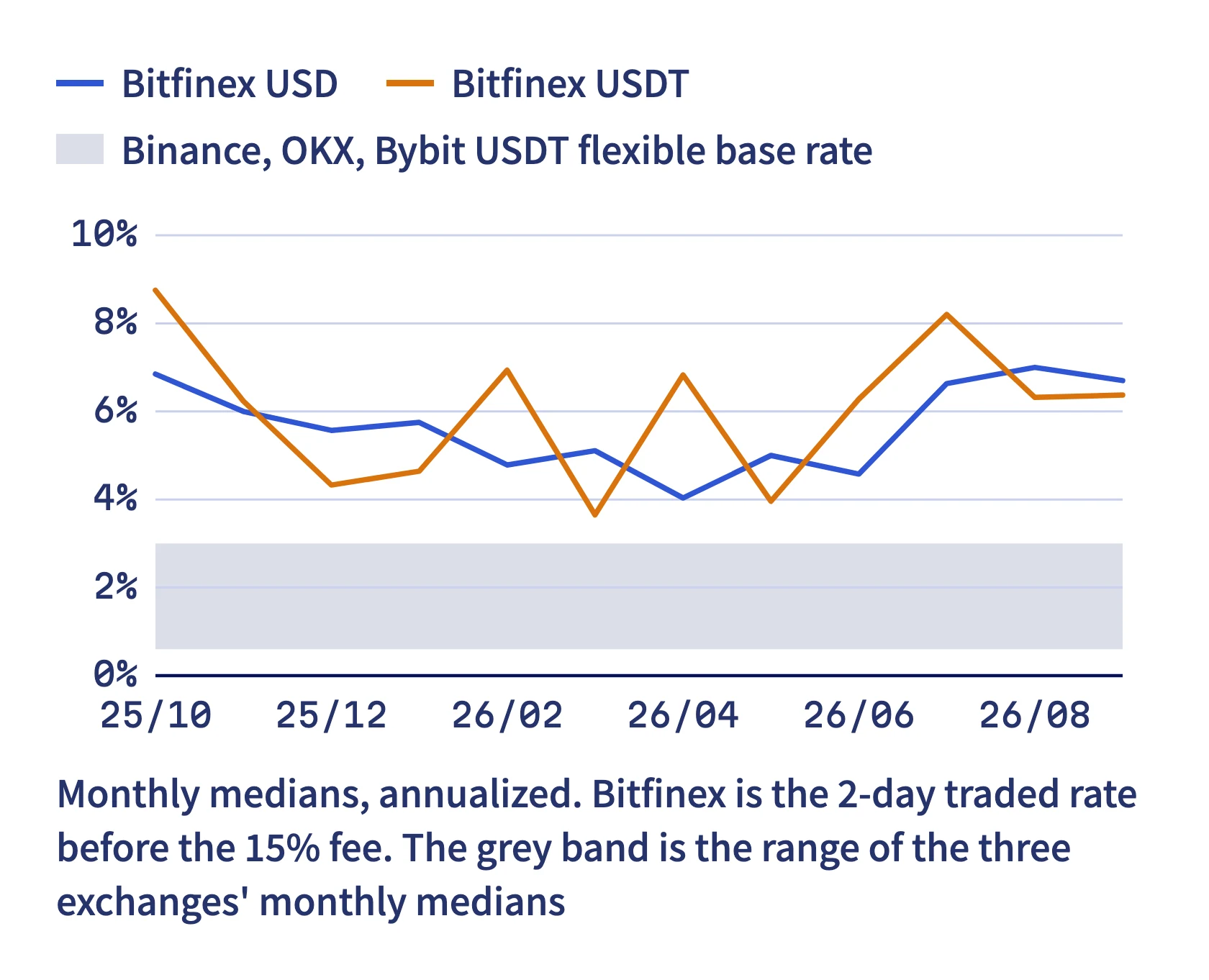 October 2025 to September 2026. Sources: Bitfinex public funding candles, and the hourly rate history each of the three exchanges publishes
The comparison has four limits.
- The Bitfinex figures are traded rates. They don't count time your offer sat unfilled, so what you actually earn is lower.
- The other three are base rates only. They add a bonus on small balances. On October 1, 2026, Binance paid a combined 6.59% on the first 1,000 USDT and Bybit paid 7.22% on the first 200 USDT. On small amounts, flexible savings isn't necessarily lower.
- It's one year of data, covering a limited range of market conditions.
- The products have different terms. A Bitfinex loan runs at least 2 days and can't be called back once it fills. Flexible savings can be redeemed at any time.
Who sets the rate
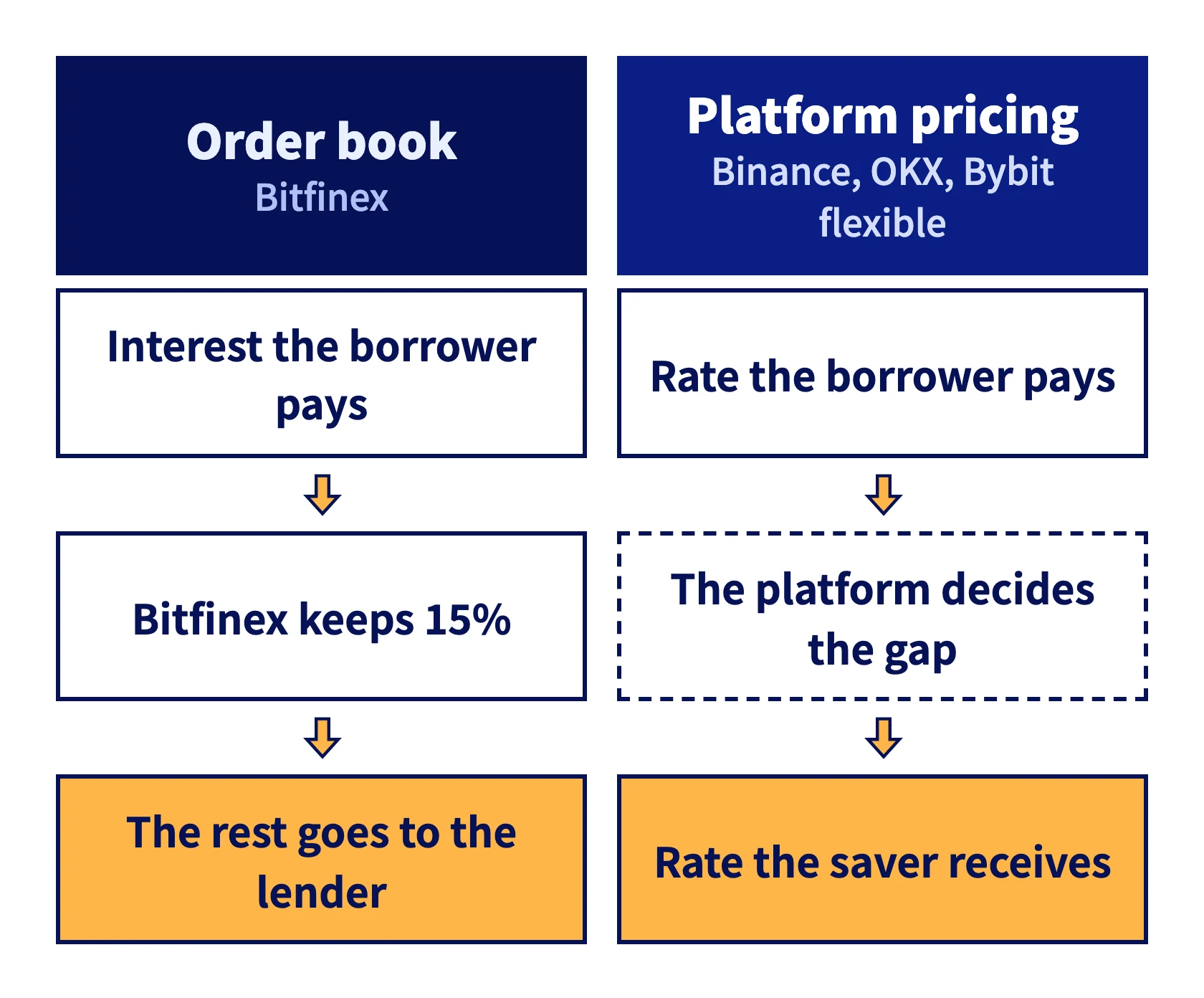
Bitfinex's funding market is an order book. Lenders post a rate and a period, borrowers post what they're willing to pay, and matching offers and bids fill. In Bitfinex's words, rates come from supply and demand and aren't set by Bitfinex.
The lender gets what the borrower pays minus Bitfinex's 15% fee. In the official interest formula, that 15% is the only difference between the two sides.
On the other three, the platform sets the rate.
- Binance: its documentation says the APR is determined at Binance's discretion and doesn't represent its actual earnings. The terms let Binance change rates unilaterally.
- OKX: since August 27, 2026, users can no longer set their own minimum lending rate. Funds go into a pool, OKX sets the borrowing rate, and the interest borrowers pay is shared pro rata among all subscribers after a 15% fee.
- Bybit: the APR updates hourly and, according to Bybit, depends on market conditions and how much of the pool is lent out.
On an order book, lenders can see what borrowers are bidding and take it. On a platform-priced product, the platform decides how far apart the borrower's rate and the saver's rate are.
Why borrowers pay that much
Most Bitfinex borrowers are margin traders, with leverage of up to 10x. Bitfinex's own example: when bitcoin rises, more traders want to borrow USD to buy it, and USD funding rates tend to rise with it.
The funding market also supplies Bitfinex Borrow, where borrowers post collateral and can withdraw what they borrow.
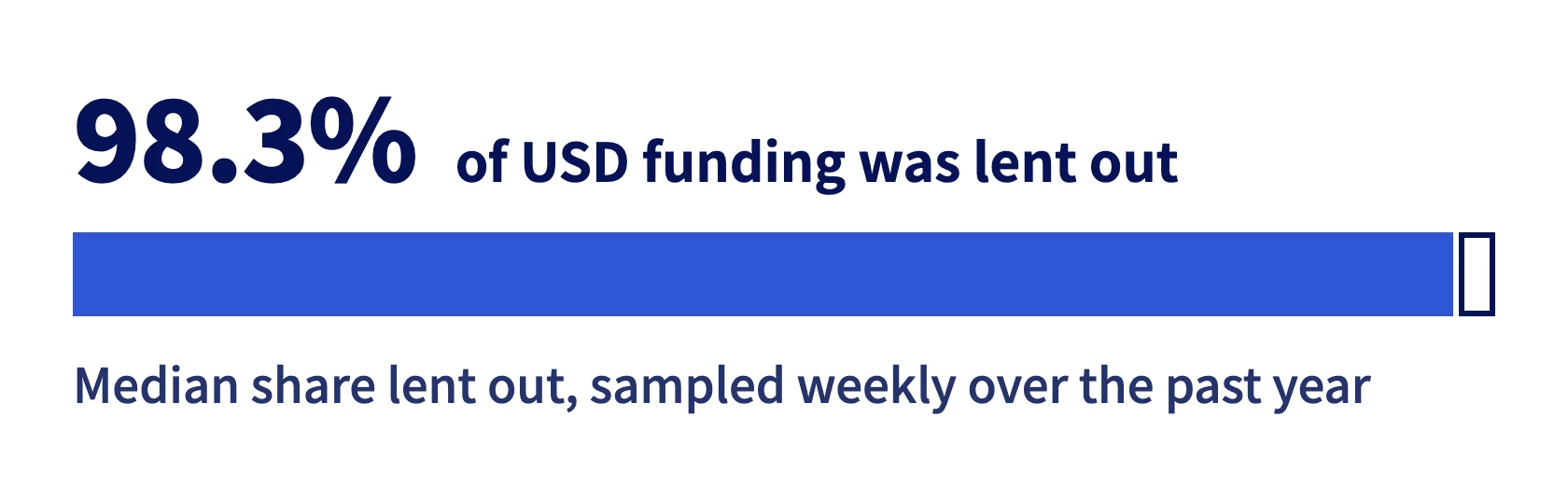
Most of the USD on offer is in use most of the time. Sampled weekly over the past year, the median share of USD funding that was lent out was 98.3%.
Rates swing widely too. Over the 12 months, the daily close for 2-day USD loans peaked at 16.2% annualized on February 10, 2026 and fell as low as 0.3% on July 2, 2026. It was at 10% or more on 35 days.
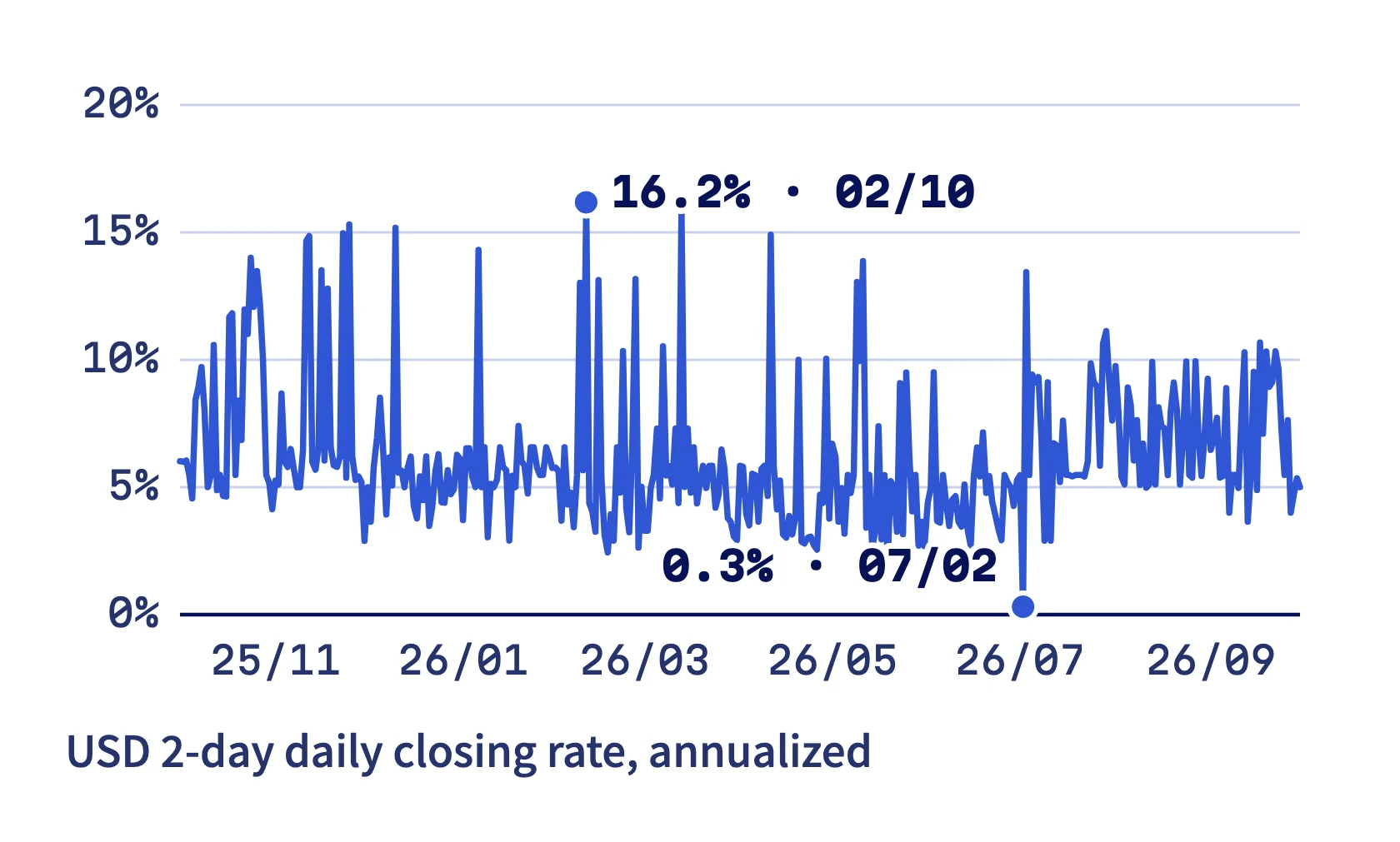 Daily closing rate for 2-day USD loans, annualized, October 2025 to September 2026. Source: Bitfinex public funding candles
What the extra interest costs you
- Your money is tied up. A filled loan can't be called back. You wait for expiry or for the borrower to repay.
- Someone has to manage it. You set the rate yourself, and if it's too high nobody borrows. After an early repayment, the money earns nothing until it's offered again.
- You carry the risk. Bitfinex's terms say it doesn't guarantee lenders against losses. Its help center adds that if prices moved so violently that most margin positions went negative, the losses would be shared with lenders, and says this has never happened.
- The money sits on an exchange. That's true of flexible savings as well, and the Binance and OKX terms also say returns aren't guaranteed.
Each of these is covered in Is Bitfinex lending safe?
How to use these numbers
For small amounts you want to reach at any time, look at each exchange's bonus tier first. That slice may pay more than Bitfinex.
For money above the bonus tier that you can leave untouched for at least 2 days, Bitfinex's traded rates were above the other three's base rates over the past year. What you actually earn depends on whether your offers fill and how long money sits idle.
Monthly traded rates are in the rate reports in the lending guide. For other ways to earn on stablecoins, see Stablecoin interest.