Bitfinex Lending Interest and Taiwan Tax: What's Known
Contents

Taiwan's Ministry of Finance has only spoken about buying and selling virtual assets. As of October 2026 there is no official guidance on how interest from lending on Bitfinex should be classified, or whether it counts as overseas income. This article lays out the rules that do exist, how the way you cash out changes things, and the questions that are still open. It is not tax advice. How you file depends on what the tax office decides.
What the Ministry has addressed: trading
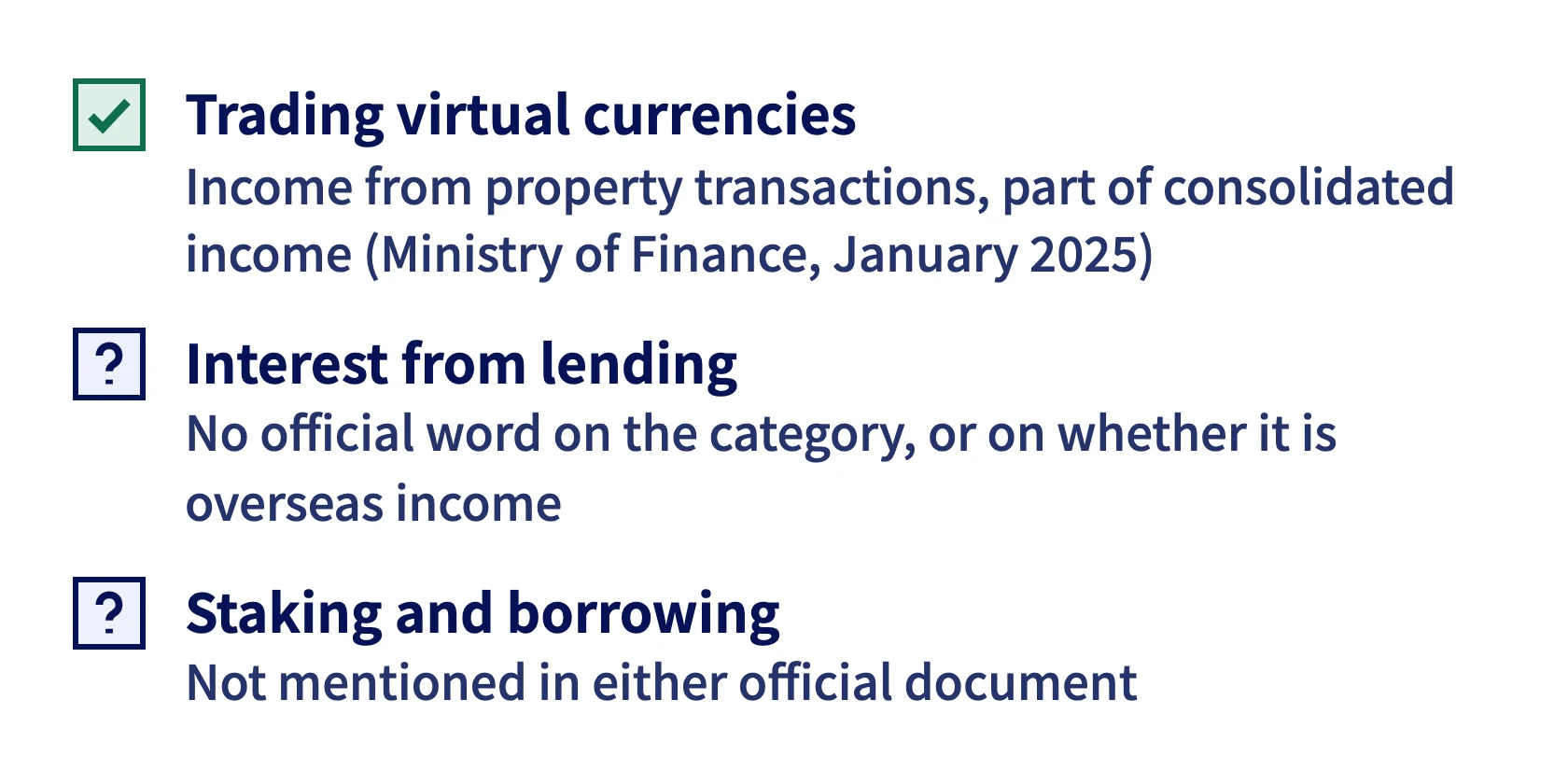
In a written report to the Legislative Yuan in January 2025, the Ministry of Finance said that gains from an individual's non-recurring trades of non-security virtual currencies are income from property transactions. You take the sale price, subtract the original cost and related expenses, and include the result in your consolidated income.
A 2022 press release from the Taxation Administration also told investors to keep proof of what their virtual assets cost.
Both documents are about trading. Neither mentions interest, staking or lending.
Lending interest has no official classification
Neither the Ministry nor any of the regional tax bureaus has issued a ruling or press release on interest from lending virtual assets.
Two categories in the Income Tax Act look close. Interest income covers "interest on other loans", and other income covers anything that doesn't fit the listed categories. The Ministry hasn't said which one applies to Bitfinex lending interest.
Accounting firms describe the same gap. In a March 2026 article, EY noted that the Ministry has only published a general report on trading, and that other types of transactions are still waiting for guidance.
How you cash out may change how you file
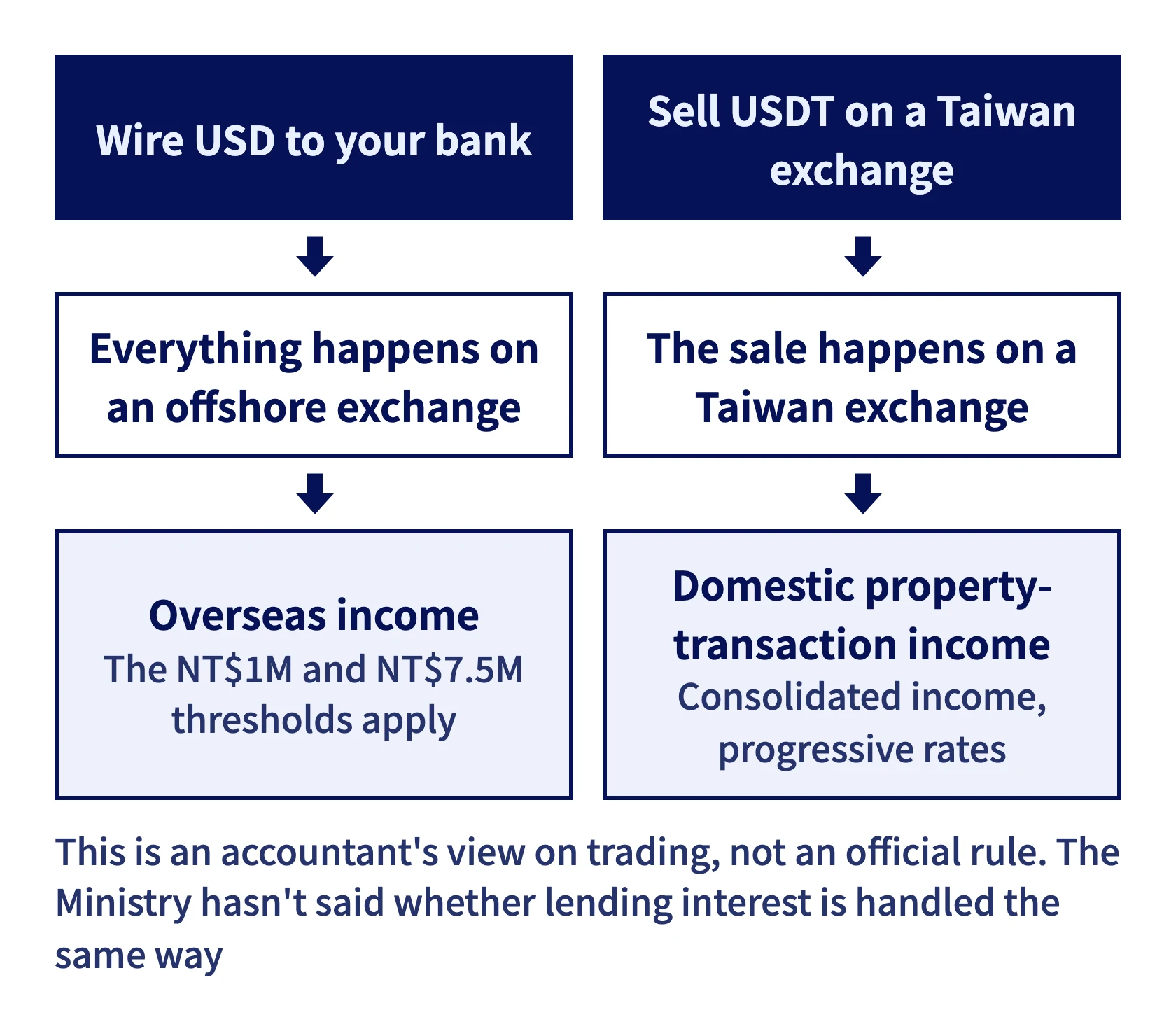
With no official word on lending interest, what accountants say about trading is the nearest reference. In a May 2026 interview, an accountant at KPMG Taiwan said domestic versus overseas depends on where the exchange is: gains made through a Taiwan exchange are domestic income from property transactions, and gains made through an offshore exchange are overseas income from property transactions. He also said income is realized on a cash basis, when the proceeds reach a bank account.
On that view, the two common ways to cash out fall under different rules.
- Wiring US dollars from Bitfinex to your bank. Everything happens on an offshore exchange, so it is overseas income and the NT$1 million and NT$7.5 million thresholds in the next section apply.
- Moving USDT to a Taiwan exchange such as MAX and selling it for New Taiwan dollars. The sale happens on a Taiwan exchange, so the gain is domestic income from property transactions. It goes into your consolidated income at progressive rates, with no NT$1 million or NT$7.5 million threshold.
The second route raises one more question: what the cost basis is for USDT you received as interest. The same accountant warned that if you can't prove your cost, there is a risk in practice that it will be treated as zero.
These are an accountant's views on trading. The Ministry hasn't explained how to tell domestic from overseas income for virtual assets, and it hasn't said whether lending interest would be handled the same way.
The fees, minimums and timing of the two routes are in Withdraw from Bitfinex to Taiwan.
The overseas income thresholds
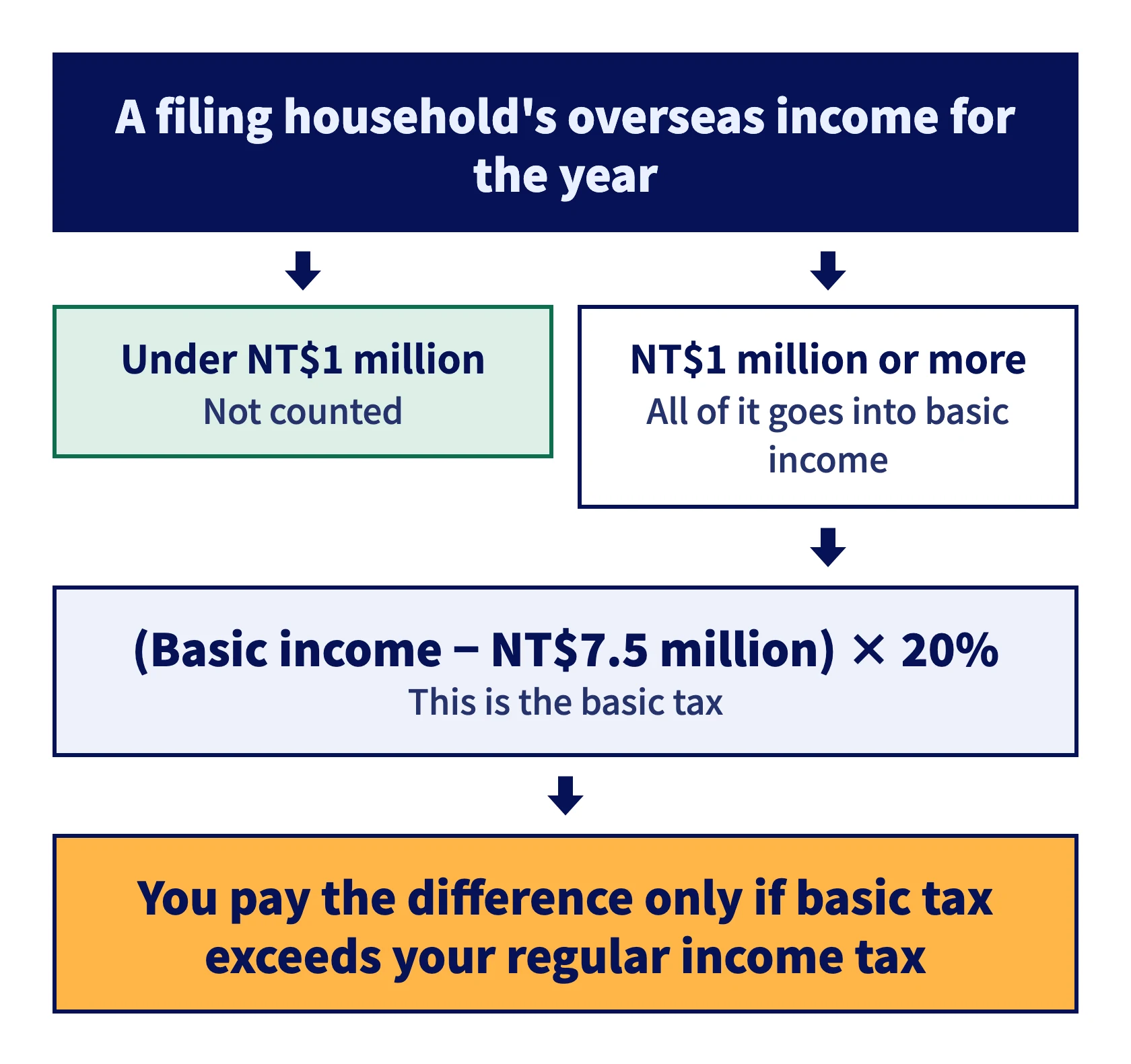
When income is treated as overseas income, the Income Basic Tax Act applies:
- If a filing household's overseas income for the year is under NT$1 million, it isn't counted.
- At NT$1 million or more, all of it is added to basic income.
- Basic tax is basic income minus NT$7.5 million, multiplied by 20%. You only pay the difference when basic tax is higher than your regular income tax.
- The NT$7.5 million deduction applies to both the 2025 and 2026 tax years.
Overseas income doesn't appear in the income data the tax office provides at filing time. You have to report it yourself.
Questions without an answer yet
- Whether lending interest is interest income, other income, or income from property transactions.
- Whether lending USD and lending USDT are treated the same way.
- When the income is realized: the day interest is credited, the day you convert to fiat, or the day it reaches your bank.
- How to convert interest received in USDT into New Taiwan dollars. The Bank of Taiwan doesn't quote a USDT rate.
- What the cost basis is when you move USDT received as interest to a Taiwan exchange and sell it.
- Whether the fee Bitfinex takes from your interest is deductible, and whether you report the gross or the net amount.
What you can do now
The authorities currently ask for two kinds of records: proof of what your virtual assets cost, and payment records when you report overseas income.
Keep these:
- Your Bitfinex ledger. You can export it from the Reports page, and it shows the interest credited each day.
- Deposit and withdrawal records, including exchange statements and bank transfer records.
- The USD exchange rate on each day interest is credited. For overseas income in a foreign currency, the rule is to use the average of the Bank of Taiwan's closing spot buying and selling rates on the payment date.

If your amount is close to a threshold or you're unsure how to file, ask the tax bureau where your household is registered, or an accountant.
What may change
The Virtual Asset Service Act was promulgated on July 22, 2026. Its effective date hasn't been set, and it contains no tax provisions. In December 2025 the Minister of Finance said tax treatment would follow the definitions in that law.
In September 2026 the Ministry issued a ruling that sales of virtual assets and stablecoins fall outside business tax. That has nothing to do with personal income tax.
For how interest is calculated and what Bitfinex keeps as a fee, see How Bitfinex lending interest works.