What Is FRR? How Bitfinex Lending Rates Are Set
Contents

Bitfinex lending has no posted rate. The price comes from the offers borrowers and lenders put on the funding book. FRR is a separate reference number that Bitfinex calculates, and first-time lenders often pick it by default.
How FRR is calculated
Bitfinex's documentation defines FRR as the average rate of all active fixed-rate loans, weighted by amount and updated every hour.
FRR tells you what money that's already lent out is earning on average. It includes loans that filled days or even weeks ago, with rates locked in back then, so it isn't the rate the market is filling at right now.
You can look up FRR for each currency on Bitfinex's Market statistics page.
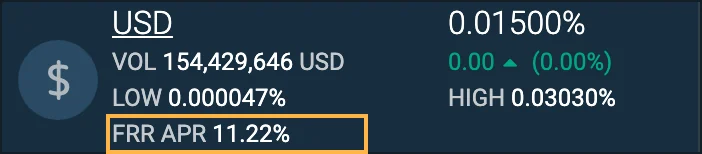 The ticker at the top left of the funding page also shows FRR as an APR (the boxed line), captured October 1, 2026
Rate units
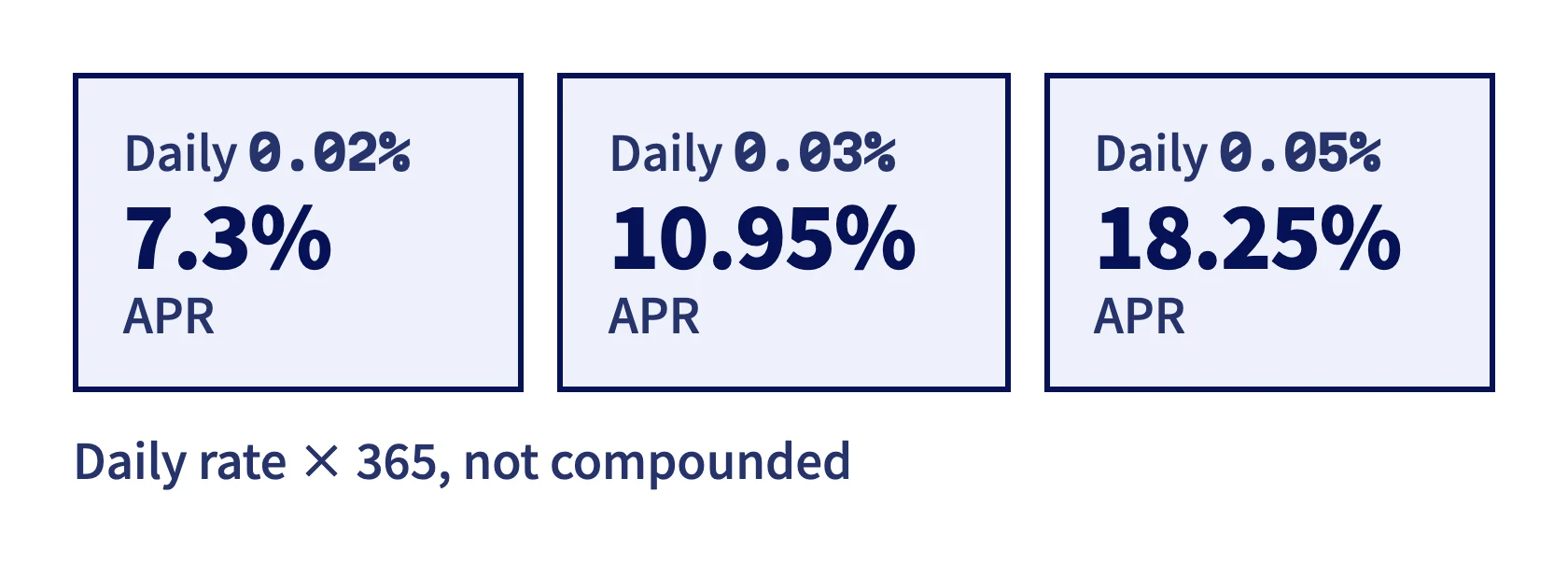
Bitfinex quotes lending rates per day. Multiply by 365 for a simple, non-compounded APR: 0.02% a day is about 7.3% a year, and 0.05% a day is about 18.25%. What you actually receive is lower after Bitfinex's fee; the math is in How Bitfinex lending interest works.
Lending rates versus the perpetual funding rate
Search for "funding rate" and you'll find two things with similar names that have nothing to do with each other.
The funding rate on Bitfinex perpetual contracts is a payment between longs and shorts, settled every 8 hours. It depends on the gap between the contract price and the mark price, and when the gap is small nothing is paid. Nobody is lending to anybody.
The lending rate is the interest borrowers pay lenders on the funding market. It's set by the offers and bids on the funding book, and interest accrues daily.
The two numbers have different sources, different payers and different settlement times, so you can't convert one into the other. A high funding rate on the derivatives page doesn't mean lending rates are high.
| Perpetual funding rate | Lending rate | |
|---|---|---|
| Who pays whom | Longs and shorts pay each other | Borrowers pay lenders |
| How it's set | The gap between the contract price and the mark price | Offers and bids on the funding book |
| Settlement | Every 8 hours | Accrues daily |
| Any lending? | No | Yes |
FRR options when you place an offer
- FRR: the rate is FRR itself, and it follows FRR hour by hour for the life of the loan.
- FRR Delta Variable: FRR plus or minus a set amount, still following FRR during the loan. Bitfinex's example: with FRR at 0.045 and a delta of 0.001, the rate is 0.046.
- FRR Delta Fixed: before the offer fills, the rate tracks FRR plus the delta. Once it fills, the rate is locked and no longer changes.
Offers at FRR don't match fixed-rate borrow requests. They only fill against borrowers who also use FRR.
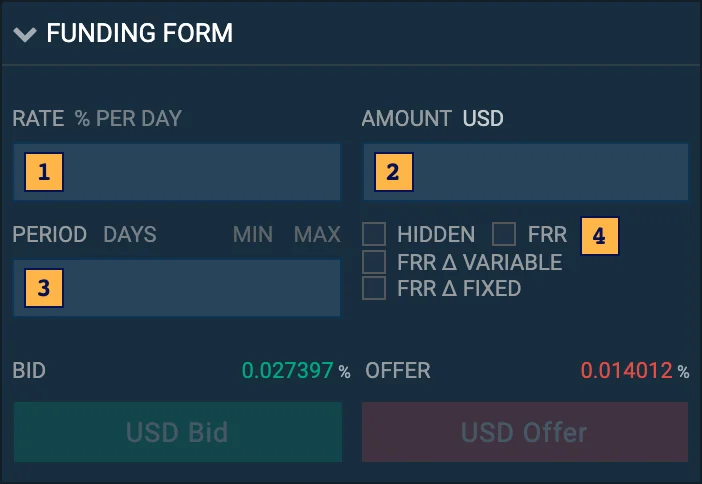 Marker 4 on the funding form is the three checkboxes: FRR, FRR Δ Variable and FRR Δ Fixed
What to watch when you lend at FRR
FRR is an average that includes older loans, so it's always a step behind when the market moves.
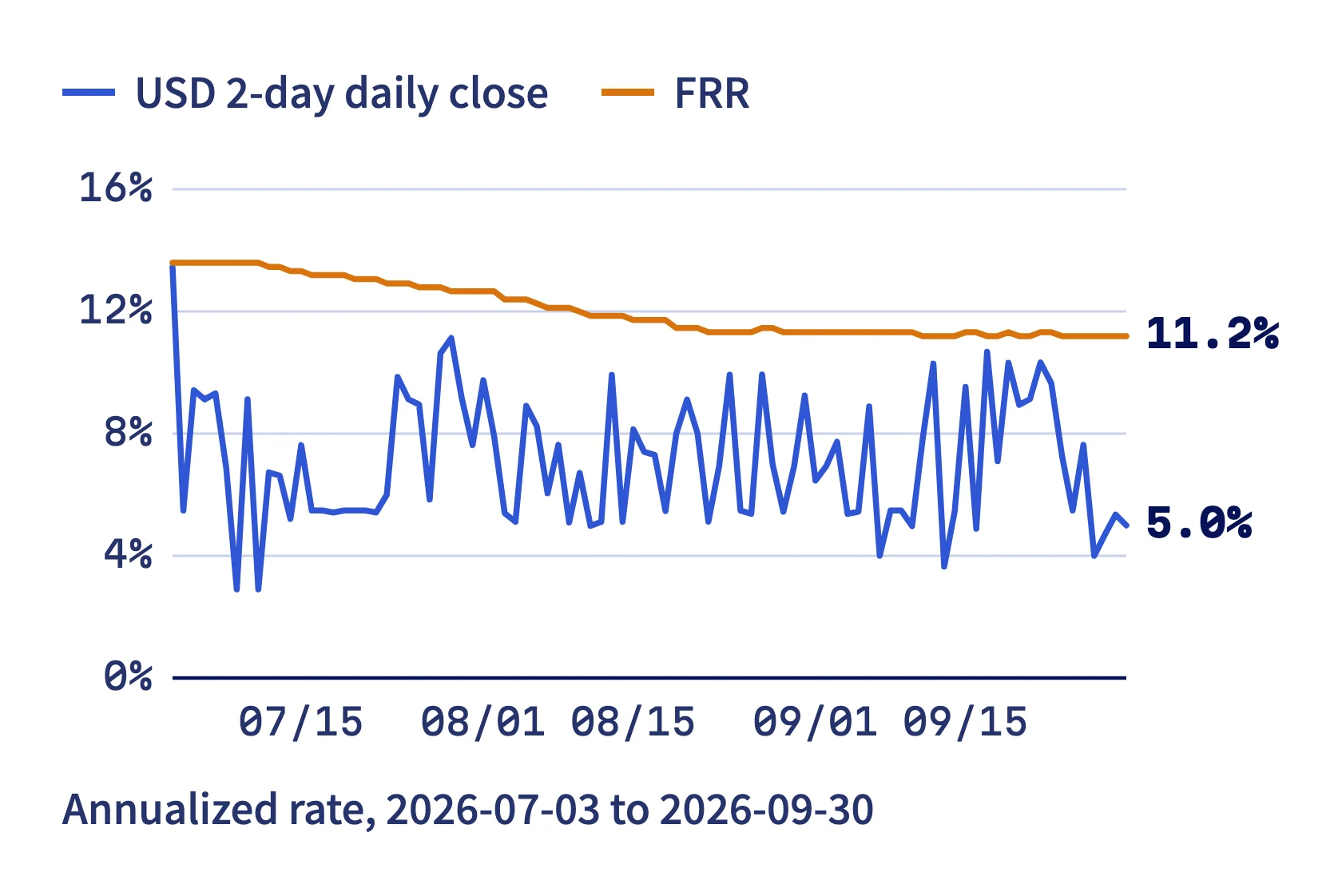 USD FRR and the daily close for 2-day loans, annualized, July 3 to September 30, 2026. Over this period FRR stayed above the 2-day close and moved far more slowly. Source: Bitfinex public API
When borrowing demand suddenly jumps, fills can run well above FRR, and lending at FRR means earning less than you could. When the market cools, the opposite happens: FRR is still sitting near the highs of the past few days, and a fixed rate priced off it may wait a long time for a borrower.
The upside is convenience. An FRR loan moves with the market average, and you never have to reprice it by hand.
EZLO doesn't use FRR as its offer price. It prices off the rates actually filling in the market. To choose how long to lend for, read Bitfinex lending period next.